21 April 2026
Residence Permit in India
Learn about the types of Indian residence permits for foreign citizens and how to apply for one when moving to India. Contact our local agents for assistance.

Foreign citizens, no matter their country of origin, must obtain various types of Indian residence permits upon moving here. These are issued in accordance with the reason for immigration and the duration of stay. This is why they are divided into several categories.
Below, our Indian agents explain the main requirements for obtaining a residence permit. They are at your disposal with tailored services related to relocation to India.
Types of residence permits available in India
India is quite offering in terms of residency, as foreign citizens can obtain around 9 or 10 types of visas and residence permits for short stays, respectively temporary immigration. First, it must be noted that, visas are required for all foreigners entering India (except citizens of Nepal and Bhutan), and those who want to stay in the country for more than 180 days must register with the FRRO.
| Quick Facts | |
|---|---|
| Visas to reside in India | Employment, business, project, family reunion, research, or medical visas, etc. |
Residency permit validity period | Varies with visa type, for instance; it is valid for 5 years with a business visa and 1 year for a medical visa. |
Minimum salary requirement | USD 25,000 per year for individuals with an employment visa. |
| Required documents for residence permit | – Passport sized photos; – Valid passport and visa; – Residency documents; – Registration fee. |
| Registration authority | Foreigners Regional Registration Office (FRRO) |
| Registration timeframe | Within 14 days of arrival, if you intend to stay more than 180 days. |
| Age exemption | Children below 12 years of age are not required to register with FRRO. |
| Pathway to permanent residency | – Investment; – By acquiring an OCI card (Overseas Citizen of India; a lifelong multiple-entry visa rather than formal permanent residence); – (PIO cards were discontinued and merged into the OCI card on 9 January 2015). |
| Investment requirement for PR status | INR 10 crore within 18 months or INR 25 crore within 36 months, plus at least 20 jobs for resident Indians each year (PRS for foreign investors) |
| OCI eligibility | Foreign nationals who were (or were eligible to become) Indian citizens on or after 26 January 1950, their descendants, and foreign spouses of Indian citizens or OCI holders (not for Pakistani or Bangladeshi nationals) |
| PIO card eligibility | PIO cards were discontinued and merged into the OCI card on 9 January 2015 |
| Spouse of the eligible person can apply for OCI (yes/no) | Yes, the spouse of a foreign national who holds an Overseas Citizen of India (OCI) Card and whose marriage has been officially registered and sustained for a continuous period of at least two years preceding the submission of the application is qualified for registration as an OCI Cardholder. |
| Online residency application | It is possible in most cases, but it is recommended to check with our specialists. |
| Foreign spouse of an Indian can get citizenship | Yes, if you’re married to an Indian citizen and have been ordinarily resident in India for seven years (the 12 months immediately before the application plus six years in the preceding eight) prior to applying for registration, you’re eligible to seek registration as an Indian citizen through an application to the Central Government of India. |
| Assistance with residency in India | Yes, you can contact our consultants in India for detailed guidance on how to get Indian residency. |
Here are the available types of temporary residence permits for India in 2026:
- the employment visa that can have a validity of 5 years depending on the job taken;
- the business visa that also has a 5-year validity;
- the project visa that can be obtained for one year or the duration of the project;
- the family reunion visa which in India is known as the X-entry visa has a 5-year validity;
- the research visa that can also be obtained for a period of 5 years;
- the medical visa with a duration of one year.
India is quite generous when it comes to residency options, which is why if you need assistance in obtaining a temporary residence permit, you can rely on our specialists who can also assist if you want to open a company in India.
Residence permit by employment in India
One of the simplest ways to immigrate to India and obtaining residency is employment. This type of visa has the advantage of being issued for up to 5 years, as well as being extendable, although employment alone does not lead to permanent residence in India.
Here are the conditions to meet in order to obtain it:
- the applicant must be a qualified professional or highly skilled worker;
- the minimum salary he or she will receive on the job must be the equivalent of USD 25,000 per year (please mind that exceptions also apply to certain professions);
- while in the country, the employee must work for the Indian company only.
Among the main aspects to consider is that foreign technicians and experts are allowed to stay in India for up to 5 years provided that a bilateral agreement between India and the applicant’s home country is in force. Also, the maximum stay for highly qualified foreign workers in the IT and related sectors is 3 years.
If you are wondering if employment is a good pathway for obtaining a residence permit in India, you should know that it is.
If you meet the requirement for becoming a permanent resident, you can rely on our advisors for the application.
We are also at your disposal if you want to start a company in India and thus move here based on a business permit. We can also provide you with tailored solutions related to taxation offered by our Indian accountants.
Residency by marriage in India
It is quite common for foreigners to obtain Indian residency by marriage. People interested in this option must know they can apply for residence permits after the wedding. The procedure implies filing for the appropriate visa, namely an Entry (X) visa for spouses of Indian nationals, and undergoing a security check with the immigration authorities. Also, the applicant must confirm being married to an Indian national through the marriage license and proof of living with the Indian spouse.
After filing for a family reunion, the foreign spouse can apply for an OCI card after two years of registered marriage and, after seven years of ordinary residence, for Indian citizenship.
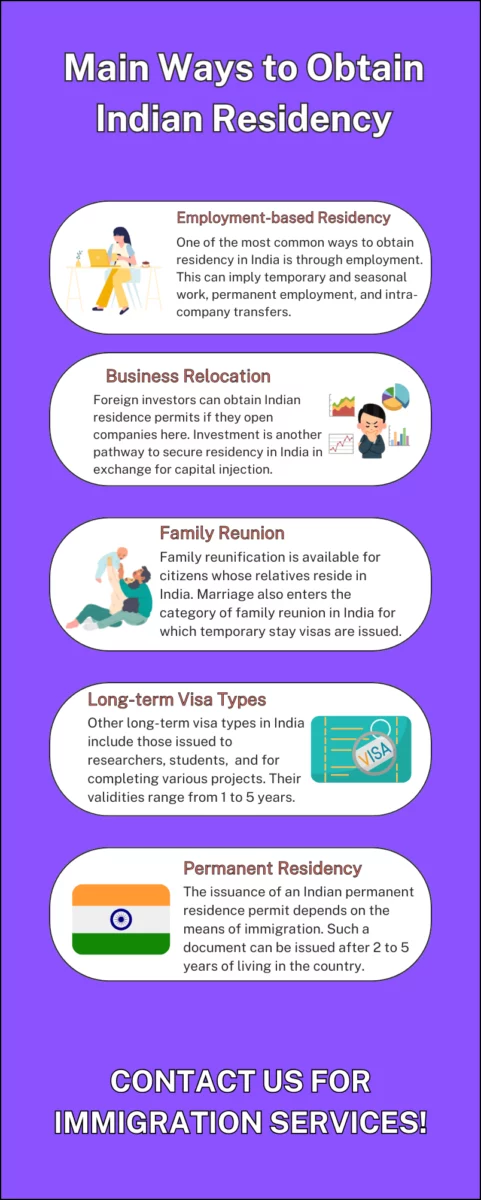
Here is also an infographic on this topic:
Registration with the FRRO in India
Natural persons who want to register a company in India or to relocate to this country for personal reasons are required to apply for a residence permit. Residence permits are necessary for persons who will live in India for a period longer than 180 days and the registration has to be started within 14 days from the day of arrival.
Those staying in India for a period of more than 180 days have to register with the Foreigners Regional Registration Office (FRRO). However, persons with an age below 12 are not required to register for a residence permit in India and our local representatives may offer in-depth advice on the procedures imposed in this case and on the documents the foreigners have to submit.
In order to obtain a residence permit in India, foreigners are required to register with the FRRO available in the area where the person will live. FRROs operate in major Indian cities, including:
- Delhi;
- Mumbai;
- Kolkata;
- Amritsar;
- Bengaluru;
- Chennai;
- Hyderabad.
In the situation in which foreigners will live in other regions than the ones mentioned above, they will need to register with the District Superintendents of Police operating in their region, as the institution works under the FRRO and has the legal right to perform this procedure.
These institutions will provide a certificate of registration, which can be further used for obtaining a residence permit in 2026 and our team of consultants in company formation in India can provide in-depth information on this matter.
Who is exempted from registering with FRRO?
Please find below who is exempted from registering with FRRO:
- Registration with the Foreigners Regional Registration Office (FRRO) is not obligatory for foreigners under certain long-term visa categories, such as Business/Entry (X) and Journalist Visas, if their stay doesn’t exceed 180 days in a single visit;
- However, if a foreigner plans to extend their stay beyond 180 days, registration must be completed well before reaching this limit;
- Certain groups of foreigners are exempt from mandatory FRRO registration:
- Holders of an OCI Card (Overseas Citizens of India) benefit from a streamlined process due to their special status;
- US nationals with ten-year tourist or business visas are exempt, provided their continuous stay does not exceed six months per visit;
- Foreigners of Indian Origin with five-year multiple entry X visas, explicitly indicating a maximum stay of six months per visit, are also exempt;
- Children under the age of 12 are exempt from mandatory registration, acknowledging the unique circumstances associated with minors.
Documents required to obtain a residence permit in India in 2026
Persons wishing to apply for a residence permit in India in 2026 will need to provide the following documents:
- four passport photos;
- a valid passport and a valid visa;
- three copies of the passport page containing the photo and the valid visa;
- copies of the documents stating the person’s residency in India;
- registration fee.
Persons who arrive here for starting a company in India will be required to offer specific documents, besides those mentioned above. Company representatives have to provide information on the Permanent Account Number, a letter in a specific format signed by the company’s director, and other corporate documents.
Our agents can offer detailed information on how to obtain residency in India in 2026.
Obtaining Indian permanent residency
There are several ways of securing the permanent resident status (PRC) in India, as indicated below:
- investment is the main option for non-Indian citizens and it implies investing at least INR 10 crore within 18 months (or INR 25 crore within 36 months) and creating at least 20 jobs for resident Indians each year; PRS is granted for up to 10 years, renewable;
- obtaining the Overseas Citizen of India (OCI) card, if you have Indian origin but have renounced Indian citizenship and desire to return;
- by obtaining an OCI card if you are a descendant of Indian citizens, as PIO cards were merged into the OCI scheme on 9 January 2015.
These are also the main ways to qualify for Indian citizenship. However, please remember that the duration of the residence permit is different based on the scenario you fit in. However, our local experts are at your service and will help you navigate the legal requirements for permanent relocation and access to an Indian passport.
How easily can one obtain residence in India in 2026?
Moving to India in 2026 is not complicated for those who want to obtain residence permits. They can either set up companies or find employment here in order to relocate as soon as possible.
The procedure of obtaining an Indian residence permit in 2026 can be started online in most cases, however, the applicant must also consider the regulations in his/her home country and the Indian Embassy or Consulate there. Either way, our agents in India can provide tailored advice depending on the applicant’s needs.
If you have any questions on how to apply for residency in India in 2026, do not hesitate to send your questions to our advisors.
Here is also a video on this subject:
Migration rates in India
About 402 million individuals, or roughly 29% of the population, were estimated to have migrated within India’s borders in 2023 (Economic Advisory Council to the Prime Minister, 2024). Compared to the 450 million found in the 2011 Census, this is a decline of about 12%. Migration patterns have been shaped by significant changes in the labour market, increasing urbanization, and recurrent difficulties after the epidemic.
According to estimates, 200 million of these migrants were labor migrants. Those who relocated for marriage are not included in this number. The foundation of the country’s economy is made up of migrant workers. They fuel the growth of urban agglomerations and industrial clusters in several states. However, among these workers are also seasonal ones.
Businessmen are invited to contact our team of specialists, who can assist with specific details on the residence permit. Persons arriving in the country for business purposes and who are interested in how to form a company in India as a foreigner can be assisted by our agents in obtaining a residence document available for investors.
You can also rely on us for payroll solutions in India.